Rosa Barba
Under the Canopy; 2025
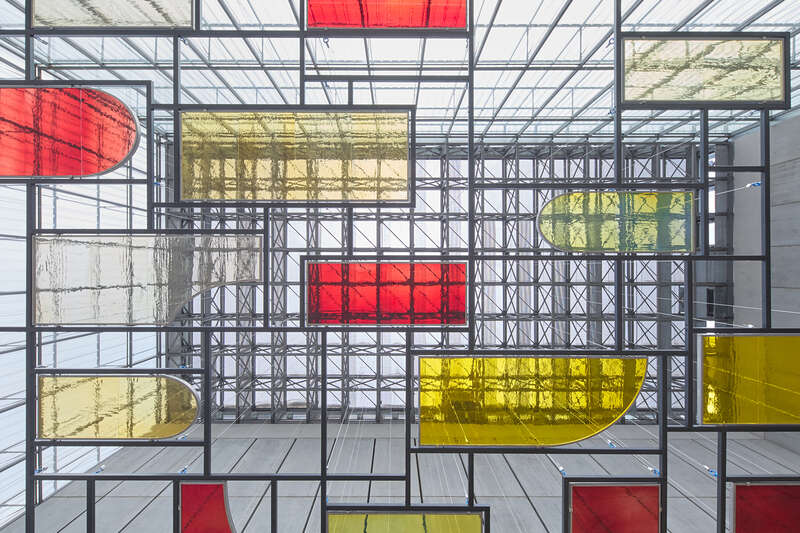
Museum der bildenden Künste Leipzig, Foto: Punctum/Alexander Schmidt, Lizenz: Alle Rechte vorbehalten/VG Bild-Kunst, Bonn 2026
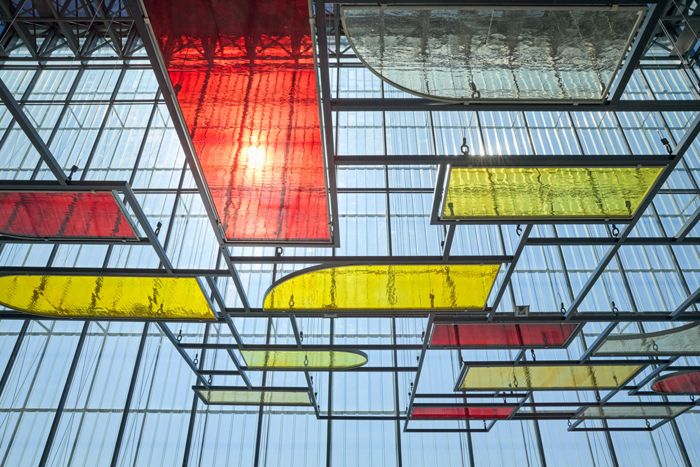
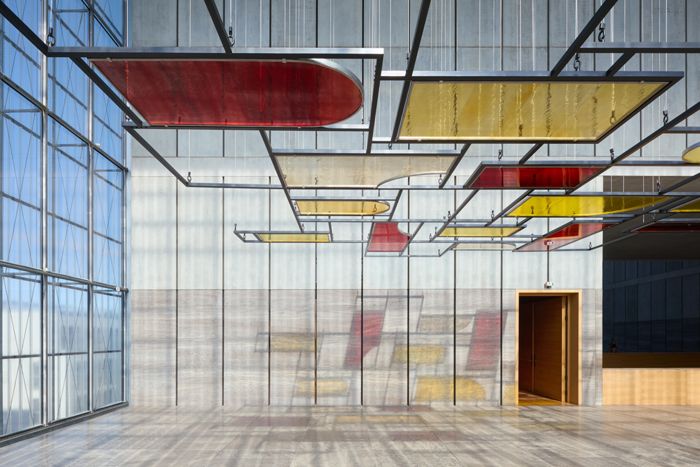
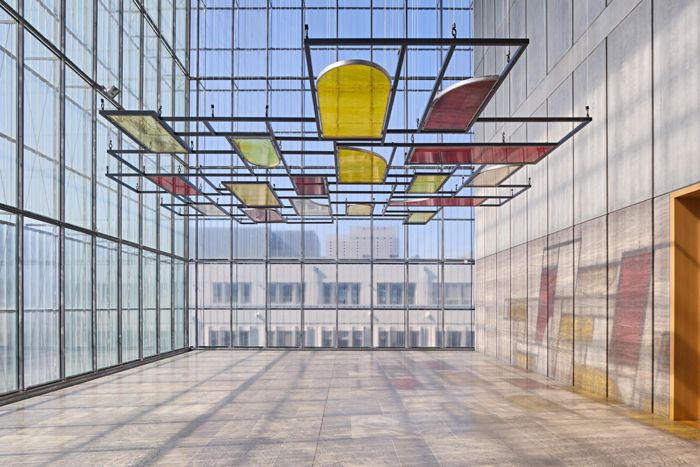
Rosa Barba, …
Under the Canopy, 2025


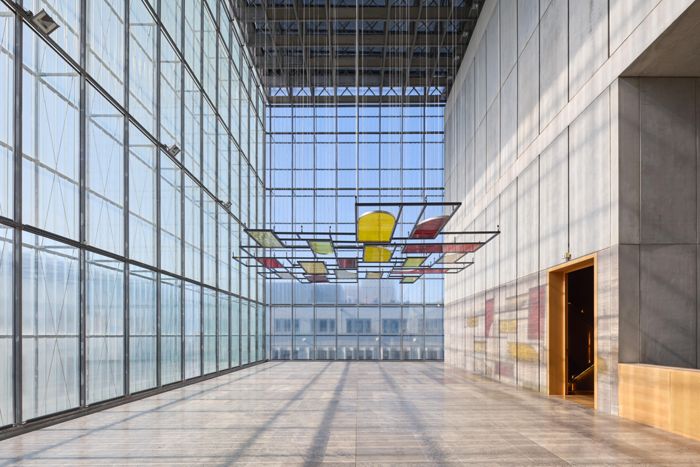
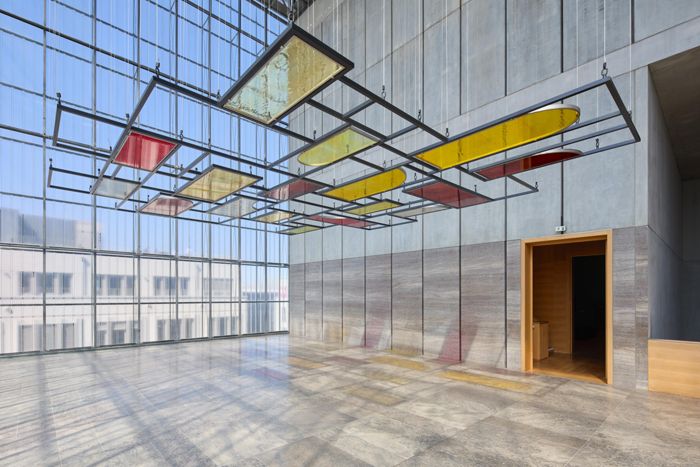
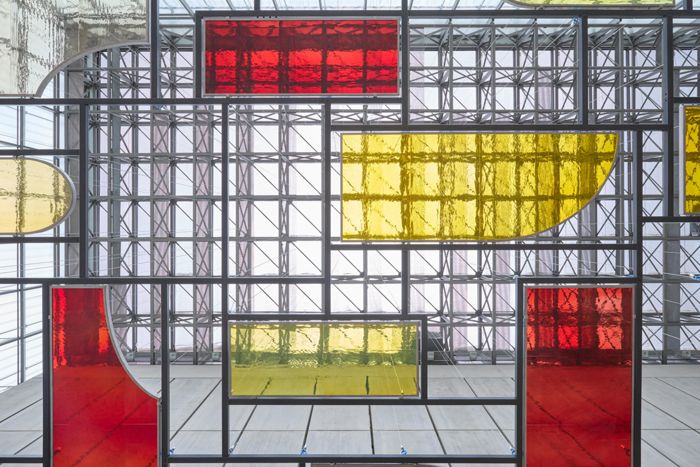
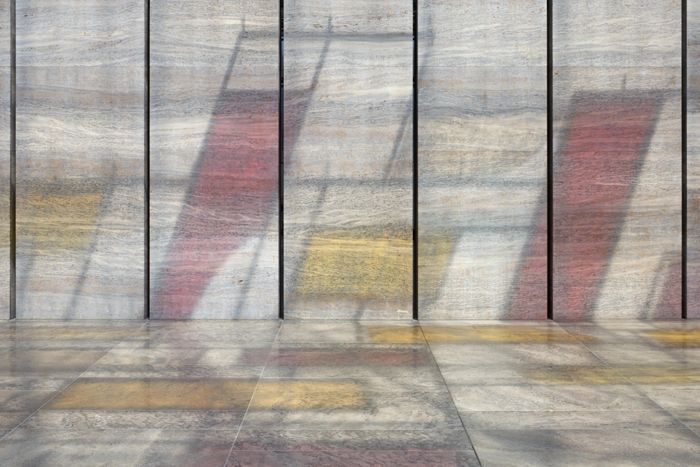
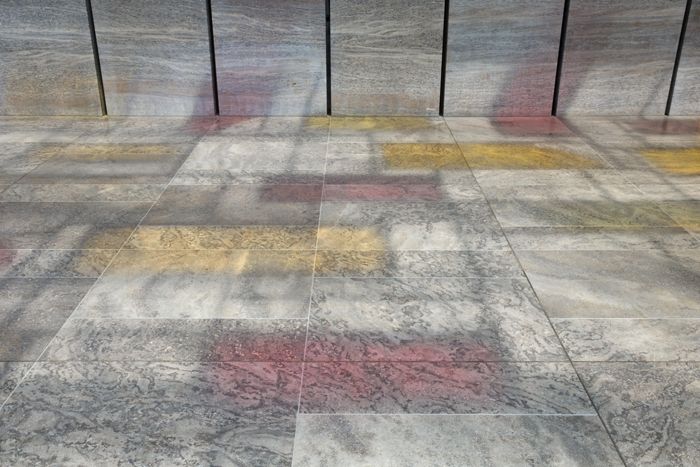
Auf der großen Lichtterrasse im zweiten Obergeschoss des MdbK hat die deutsch-italienische Künstlerin und Filmemacherin Rosa Barba (*1972) die ortsspezifische Arbeit "Under the Canopy" installiert. Barba verwandelt die – mit einer Fläche von 300 m² und einer Raumhöhe von 17 m – größte Terrasse des MdbK in eine projizierende Kamera. Dafür hat die Künstlerin mundgeblasene bunte Glasscheiben in ein schwebendes Gitter eingelassen. Maße und Untergliederungen der Gitterflächen sind proportional an dem gebauten Raum orientiert. Auf diese Weise erhält die Terrasse in etwa vier Metern Höhe eine Art zweite Decke: Es entsteht ein Raum im Raum, der sich transparent auf ein Dahinter und Darüber öffnet. Zugleich fällt das Sonnenlicht durch die Glasfronten der Installation und zeichnet sich auf Boden und Wänden ab. Die Terrasse wird wie ein riesiges Objektiv erfahrbar, das Licht sammelt und es in den Raum projiziert. Durch diesen monumentalen fotografischen Vorgang erhält Zeit eine Gestalt.
Aktiviert durch die Sonne wird die Architektur in den performativen Akt einbezogen: Je nach Stand und Intensität des Sonnenlichts sind die Flächen im Raum in Bewegung, die Lichtzeichnung ereignet sich je nach Tages- und Jahreszeit aufs Neue. Die Besucher*innen nehmen durch ihre Position innerhalb dieses Zeit-Raumes am Prozess der ‚Verräumlichung‘ von Zeit teil. Das oft unbemerkte Raum-Zeit-Gefüge wird so erfahrbar und ins Bewusstsein gesetzt.
Rosa Barba thematisiert zugleich eine fundamentale Verschiebung: Während digitale Räume zunehmend unsere Wahrnehmung bestimmen, bleiben Raum und Zeit eindeutig physische Erfahrungen. So betont die Künstlerin die Relevanz der analogen menschlichen Existenz in einer digitalen Welt.
Seit den 1990er Jahren setzt sich Rosa Barba mit der Interaktion von Film und Architektur, letztlich also mit Wahrnehmungsbedingungen, auseinander. Indem sie die fiktive Projektion mit dem realen, physischen Ort zu einem Erfahrungsraum vereint, erschafft sie neue narrative Möglichkeiten. In früheren Werkphasen entstanden dabei mechanische Objekte, die Informationen in Echtzeit generieren und in ihren neuen Formen die Bedingungen des Kinos hinterfragen. In Weiterentwicklung dieses Ansatzes verbindet Barba in aktuellen Arbeiten theoretische Überlegungen zu Astronomie und Kino. Dabei geht es u. a. um Konzepte von Licht, Zeit und Entfernung. Die Theorien der Astronomie und des Kinos eröffnen für sie auf je eigene Weise neue, spekulative und unstete Räume, die sie mit ihrer Kunst ergründet.
Under the Canopy ist die vierte Position in der Folge der eigens für die große Eckterrasse des MdbK konzipierten Rauminstallationen – nach Chiharu Shiota Internal Line (2021/22), Hito Steyerl The City of Broken Windows (2023) und Sandra Mujinga Fleeting Home (2024/25).
On the large light-filled terrace of the second floor of the MdbK, the German-Italian artist and filmmaker Rosa Barba (*1972) has installed the site-specific work "Under the Canopy". Barba has transformed the MdbK’s largest terrace – with an area of 300 square metres and a height of 17 metres – into a projecting camera. For this purpose, the artist has set hand-blown coloured glass panes into a floating grid. The dimensions and partitions of the grid surfaces are proportionally oriented to the constructed space. In this way, the terrace is given a kind of second ceiling at a height of around 4 metres, resulting in a room within a room that opens up transparently to a space behind and above. All the while, the sunlight shines through the glass fronts of the installation and is reflected on the floor and walls. The terrace can be experienced as a giant lens that collects light and projects it into the room. Through this monumental photographic process, time acquires shape.
Activated by the sun, the architecture is integrated into the performative act: The surfaces in the room shift depending on the position and intensity of the sunlight, and the pattern of light changes depending on the time of day and season. Through their position within this time-space, visitors take part in the process of the “spatialization” of time. The often-unnoticed space-time structure is thus made tangible and brought to awareness.
At the same time, Rosa Barba addresses a fundamental shift: While digital spaces increasingly define our perception, space and time clearly remain physical experiences. The artist thus emphasizes the relevance of analogue human existence in a digital world.
Since the 1990s, Rosa Barba has been grappling with the interaction of film and architecture – ultimately, that is, with the conditions of perception. By joining the fictional projection with the real, physical location in order to make a space of experience, she creates new narrative possibilities. In earlier phases of her work, mechanical objects were created that generate information in real time and that, in their new forms, question the conditions of cinema. In her current works, Barba further develops this approach by combining theoretical considerations on astronomy and cinema. At issue are concepts of light, time and distance. Theories of astronomy and cinema – each in their own way – open up new, speculative and unstable spaces that she explores with her art.
Under the Canopy is the fourth project in the series of spatial installations conceived specifically for the large corner terrace of the MdbK – following Chiharu Shiota Internal Line (2021/22), Hito Steyerl The City of Broken Windows (2023) and Sandra Mujinga Fleeting Home (2024/25).
Beteiligte Rosa Barba (1972)
Titel Under the Canopy
Entstehungszeit 2025
Systematik Objekt / Installation
Material/Technik Rahmenkonstruktion: Baustahl; mundgeblasenes, einlaminiertes LambertsGlas (4mm) in unterschiedlichen Farben und Größen; Drahtseile
Technik
Signatur Unbez.
Creditline Courtesy the artist, Esther Schipper Gallery Berlin
Zitiervorschlag/Permalink Rosa Barba, Under the Canopy, 2025, Rahmenkonstruktion: Baustahl; mundgeblasenes, einlaminiertes LambertsGlas (4mm) in unterschiedlichen Farben und Größen; Drahtseile, Courtesy the artist, Esther Schipper Gallery Berlin, Copyright Abb. © Museum der bildenden Künste Leipzig, Foto: Punctum/Alexander Schmidt, Lizenz: Alle Rechte vorbehalten/VG Bild-Kunst, Bonn 2026, https://mdbk-digital.de/detail/collection/8c841caa-acde-4912-a1ee-6888a311fec7
Die Werkangaben auf MdbK [digital] entsprechen dem gegenwärtigen Stand der Forschung und werden laufend aktualisiert. Das MdbK forscht kontinuierlich zu seinem Bestand und dessen Provenienzen. Wir verpflichten uns dabei, die fach- und disziplinspezifischen Standards zu wahren. MdbK [digital] ist ein Instrument, diese Forschungsergebnisse sichtbar zu machen. Wenn Sie Fragen oder Hinweise zu den Objekten haben, freuen wir uns über Ihre Nachricht.
Rosa Barba
- Key: 8c841caa-acde-4912-a1ee-6888a311fec7
- Module_ref: collection
- Create_date: 2025-04-25T08:25:54Z
- Change_date: 2026-08-27T10:12:21Z
- Sync_date: 2026-09-20T20:36:49Z
- Container_S: MdbK Sammlung - Dauerleihen
- Container_S_multi_facet: MdbK Sammlung - Dauerleihen
- SimpleSearch: MdbK Sammlung - Dauerleihen,MdbK Objekt / Installation,Under the Canopy,Objekt / Installation,Courtesy the artist, Esther Schipper Gallery Berlin,2025,2025,Unbez.,Barba, Rosa,Under the Canopy,Unbez.,Auf der großen Lichtterrasse im zweiten Obergeschoss des MdbK hat die deutsch-italienische Künstlerin und Filmemacherin Rosa Barba (*1972) die ortsspezifische Arbeit "Under the Canopy" installiert. Barba verwandelt die – mit einer Fläche von 300 m² und einer Raumhöhe von 17 m – größte Terrasse des MdbK in eine projizierende Kamera. Dafür hat die Künstlerin mundgeblasene bunte Glasscheiben in ein schwebendes Gitter eingelassen. Maße und Untergliederungen der Gitterflächen sind proportional an dem gebauten Raum orientiert. Auf diese Weise erhält die Terrasse in etwa vier Metern Höhe eine Art zweite Decke: Es entsteht ein Raum im Raum, der sich transparent auf ein Dahinter und Darüber öffnet. Zugleich fällt das Sonnenlicht durch die Glasfronten der Installation und zeichnet sich auf Boden und Wänden ab. Die Terrasse wird wie ein riesiges Objektiv erfahrbar, das Licht sammelt und es in den Raum projiziert. Durch diesen monumentalen fotografischen Vorgang erhält Zeit eine Gestalt.<br class="linefeed" />Aktiviert durch die Sonne wird die Architektur in den performativen Akt einbezogen: Je nach Stand und Intensität des Sonnenlichts sind die Flächen im Raum in Bewegung, die Lichtzeichnung ereignet sich je nach Tages- und Jahreszeit aufs Neue. Die Besucher*innen nehmen durch ihre Position innerhalb dieses Zeit-Raumes am Prozess der ‚Verräumlichung‘ von Zeit teil. Das oft unbemerkte Raum-Zeit-Gefüge wird so erfahrbar und ins Bewusstsein gesetzt. <br class="linefeed" />Rosa Barba thematisiert zugleich eine fundamentale Verschiebung: Während digitale Räume zunehmend unsere Wahrnehmung bestimmen, bleiben Raum und Zeit eindeutig physische Erfahrungen. So betont die Künstlerin die Relevanz der analogen menschlichen Existenz in einer digitalen Welt.<br class="linefeed" />Seit den 1990er Jahren setzt sich Rosa Barba mit der Interaktion von Film und Architektur, letztlich also mit Wahrnehmungsbedingungen, auseinander. Indem sie die fiktive Projektion mit dem realen, physischen Ort zu einem Erfahrungsraum vereint, erschafft sie neue narrative Möglichkeiten. In früheren Werkphasen entstanden dabei mechanische Objekte, die Informationen in Echtzeit generieren und in ihren neuen Formen die Bedingungen des Kinos hinterfragen. In Weiterentwicklung dieses Ansatzes verbindet Barba in aktuellen Arbeiten theoretische Überlegungen zu Astronomie und Kino. Dabei geht es u. a. um Konzepte von Licht, Zeit und Entfernung. Die Theorien der Astronomie und des Kinos eröffnen für sie auf je eigene Weise neue, spekulative und unstete Räume, die sie mit ihrer Kunst ergründet.<br class="linefeed" />Under the Canopy ist die vierte Position in der Folge der eigens für die große Eckterrasse des MdbK konzipierten Rauminstallationen – nach Chiharu Shiota Internal Line (2021/22), Hito Steyerl The City of Broken Windows (2023) und Sandra Mujinga Fleeting Home (2024/25). ,On the large light-filled terrace of the second floor of the MdbK, the German-Italian artist and filmmaker Rosa Barba (*1972) has installed the site-specific work "Under the Canopy". Barba has transformed the MdbK’s largest terrace – with an area of 300 square metres and a height of 17 metres – into a projecting camera. For this purpose, the artist has set hand-blown coloured glass panes into a floating grid. The dimensions and partitions of the grid surfaces are proportionally oriented to the constructed space. In this way, the terrace is given a kind of second ceiling at a height of around 4 metres, resulting in a room within a room that opens up transparently to a space behind and above. All the while, the sunlight shines through the glass fronts of the installation and is reflected on the floor and walls. The terrace can be experienced as a giant lens that collects light and projects it into the room. Through this monumental photographic process, time acquires shape.<br class="linefeed" />Activated by the sun, the architecture is integrated into the performative act: The surfaces in the room shift depending on the position and intensity of the sunlight, and the pattern of light changes depending on the time of day and season. Through their position within this time-space, visitors take part in the process of the “spatialization” of time. The often-unnoticed space-time structure is thus made tangible and brought to awareness. <br class="linefeed" />At the same time, Rosa Barba addresses a fundamental shift: While digital spaces increasingly define our perception, space and time clearly remain physical experiences. The artist thus emphasizes the relevance of analogue human existence in a digital world.<br class="linefeed" />Since the 1990s, Rosa Barba has been grappling with the interaction of film and architecture – ultimately, that is, with the conditions of perception. By joining the fictional projection with the real, physical location in order to make a space of experience, she creates new narrative possibilities. In earlier phases of her work, mechanical objects were created that generate information in real time and that, in their new forms, question the conditions of cinema. In her current works, Barba further develops this approach by combining theoretical considerations on astronomy and cinema. At issue are concepts of light, time and distance. Theories of astronomy and cinema – each in their own way – open up new, speculative and unstable spaces that she explores with her art.<br class="linefeed" />Under the Canopy is the fourth project in the series of spatial installations conceived specifically for the large corner terrace of the MdbK – following Chiharu Shiota Internal Line (2021/22), Hito Steyerl The City of Broken Windows (2023) and Sandra Mujinga Fleeting Home (2024/25).<br class="linefeed" />
- SimpleSearch2: MdbK Sammlung - Dauerleihen,MdbK Objekt / Installation,Under the Canopy,Objekt / Installation,Courtesy the artist, Esther Schipper Gallery Berlin,2025,2025,Unbez.,Barba, Rosa,Under the Canopy,Unbez.,Auf der großen Lichtterrasse im zweiten Obergeschoss des MdbK hat die deutsch-italienische Künstlerin und Filmemacherin Rosa Barba (*1972) die ortsspezifische Arbeit "Under the Canopy" installiert. Barba verwandelt die – mit einer Fläche von 300 m² und einer Raumhöhe von 17 m – größte Terrasse des MdbK in eine projizierende Kamera. Dafür hat die Künstlerin mundgeblasene bunte Glasscheiben in ein schwebendes Gitter eingelassen. Maße und Untergliederungen der Gitterflächen sind proportional an dem gebauten Raum orientiert. Auf diese Weise erhält die Terrasse in etwa vier Metern Höhe eine Art zweite Decke: Es entsteht ein Raum im Raum, der sich transparent auf ein Dahinter und Darüber öffnet. Zugleich fällt das Sonnenlicht durch die Glasfronten der Installation und zeichnet sich auf Boden und Wänden ab. Die Terrasse wird wie ein riesiges Objektiv erfahrbar, das Licht sammelt und es in den Raum projiziert. Durch diesen monumentalen fotografischen Vorgang erhält Zeit eine Gestalt.<br class="linefeed" />Aktiviert durch die Sonne wird die Architektur in den performativen Akt einbezogen: Je nach Stand und Intensität des Sonnenlichts sind die Flächen im Raum in Bewegung, die Lichtzeichnung ereignet sich je nach Tages- und Jahreszeit aufs Neue. Die Besucher*innen nehmen durch ihre Position innerhalb dieses Zeit-Raumes am Prozess der ‚Verräumlichung‘ von Zeit teil. Das oft unbemerkte Raum-Zeit-Gefüge wird so erfahrbar und ins Bewusstsein gesetzt. <br class="linefeed" />Rosa Barba thematisiert zugleich eine fundamentale Verschiebung: Während digitale Räume zunehmend unsere Wahrnehmung bestimmen, bleiben Raum und Zeit eindeutig physische Erfahrungen. So betont die Künstlerin die Relevanz der analogen menschlichen Existenz in einer digitalen Welt.<br class="linefeed" />Seit den 1990er Jahren setzt sich Rosa Barba mit der Interaktion von Film und Architektur, letztlich also mit Wahrnehmungsbedingungen, auseinander. Indem sie die fiktive Projektion mit dem realen, physischen Ort zu einem Erfahrungsraum vereint, erschafft sie neue narrative Möglichkeiten. In früheren Werkphasen entstanden dabei mechanische Objekte, die Informationen in Echtzeit generieren und in ihren neuen Formen die Bedingungen des Kinos hinterfragen. In Weiterentwicklung dieses Ansatzes verbindet Barba in aktuellen Arbeiten theoretische Überlegungen zu Astronomie und Kino. Dabei geht es u. a. um Konzepte von Licht, Zeit und Entfernung. Die Theorien der Astronomie und des Kinos eröffnen für sie auf je eigene Weise neue, spekulative und unstete Räume, die sie mit ihrer Kunst ergründet.<br class="linefeed" />Under the Canopy ist die vierte Position in der Folge der eigens für die große Eckterrasse des MdbK konzipierten Rauminstallationen – nach Chiharu Shiota Internal Line (2021/22), Hito Steyerl The City of Broken Windows (2023) und Sandra Mujinga Fleeting Home (2024/25). ,On the large light-filled terrace of the second floor of the MdbK, the German-Italian artist and filmmaker Rosa Barba (*1972) has installed the site-specific work "Under the Canopy". Barba has transformed the MdbK’s largest terrace – with an area of 300 square metres and a height of 17 metres – into a projecting camera. For this purpose, the artist has set hand-blown coloured glass panes into a floating grid. The dimensions and partitions of the grid surfaces are proportionally oriented to the constructed space. In this way, the terrace is given a kind of second ceiling at a height of around 4 metres, resulting in a room within a room that opens up transparently to a space behind and above. All the while, the sunlight shines through the glass fronts of the installation and is reflected on the floor and walls. The terrace can be experienced as a giant lens that collects light and projects it into the room. Through this monumental photographic process, time acquires shape.<br class="linefeed" />Activated by the sun, the architecture is integrated into the performative act: The surfaces in the room shift depending on the position and intensity of the sunlight, and the pattern of light changes depending on the time of day and season. Through their position within this time-space, visitors take part in the process of the “spatialization” of time. The often-unnoticed space-time structure is thus made tangible and brought to awareness. <br class="linefeed" />At the same time, Rosa Barba addresses a fundamental shift: While digital spaces increasingly define our perception, space and time clearly remain physical experiences. The artist thus emphasizes the relevance of analogue human existence in a digital world.<br class="linefeed" />Since the 1990s, Rosa Barba has been grappling with the interaction of film and architecture – ultimately, that is, with the conditions of perception. By joining the fictional projection with the real, physical location in order to make a space of experience, she creates new narrative possibilities. In earlier phases of her work, mechanical objects were created that generate information in real time and that, in their new forms, question the conditions of cinema. In her current works, Barba further develops this approach by combining theoretical considerations on astronomy and cinema. At issue are concepts of light, time and distance. Theories of astronomy and cinema – each in their own way – open up new, speculative and unstable spaces that she explores with her art.<br class="linefeed" />Under the Canopy is the fourth project in the series of spatial installations conceived specifically for the large corner terrace of the MdbK – following Chiharu Shiota Internal Line (2021/22), Hito Steyerl The City of Broken Windows (2023) and Sandra Mujinga Fleeting Home (2024/25).<br class="linefeed" />
- Type_S: MdbK Objekt / Installation
- Type_S_multi_facet: MdbK Objekt / Installation
- TypeKey_s: 3fd48fe6-c71c-4d17-9055-e0cbe9e1d67b
- Title_S: Under the Canopy
- Title_S_sort: Under the Canopy
- Systematic_S: Objekt / Installation
- Systematic_multi_facet: Objekt / Installation
- Systematic_multi_facet_filter: Objekt / Installation
- NumberOfObjects_S: 18
- Creditline_S: Courtesy the artist, Esther Schipper Gallery Berlin
- Label_A01_3fd48fe6-c71c-4d17-9055-e0cbe9e1d67b_s: Objektgesch. (intern)
- Label_A02_3fd48fe6-c71c-4d17-9055-e0cbe9e1d67b_s: Provenienz (extern)
- Label_A03_3fd48fe6-c71c-4d17-9055-e0cbe9e1d67b_s: Provenienz (intern)
- Label_A07_3fd48fe6-c71c-4d17-9055-e0cbe9e1d67b_s: Bearbeitung
- Label_A08_3fd48fe6-c71c-4d17-9055-e0cbe9e1d67b_s: Literatur (intern)
- Dating_S: 2025
- Dating_zeit: 2025
- Dating_S2: 2025
- YearFrom_I: 2025
- YearTo_I: 2025
- Signatures_Search_S: Unbez.
- Subjects_Search_S: Barba, Rosa
- Subjects_multi_facet: Barba, Rosa
- Subjects_multi_facet_filter: Barba, Rosa
- lists_s: Titles,Signatures,GeographicReferences,InventoryNumbers,OtherNumbers,KeywordChain,MaterialTechnique,Dimensions,Dating,Texts,ObjectRelations,Subjects,Literature,Exhibitions,Uri,WebLinks,Media
- list_Titles_I: 1
- Titles_Type_0_S: Originaltitel
- Titles_Text_0_S: Under the Canopy
- list_Signatures_I: 1
- Signatures_Type_0_S: Ausgabe
- Signatures_Text_0_S: Unbez.
- list_GeographicReferences_I: 0
- list_InventoryNumbers_I: 0
- list_OtherNumbers_I: 0
- list_KeywordChain_I: 0
- list_MaterialTechnique_I: 1
- MaterialTechnique_Type_0_S: Material / Technik
- MaterialTechnique_Remark_0_S: Rahmenkonstruktion: Baustahl; mundgeblasenes, einlaminiertes LambertsGlas (4mm) in unterschiedlichen Farben und Größen; Drahtseile
- MTR_multi_facet: Rahmenkonstruktion: Baustahl; mundgeblasenes, einlaminiertes LambertsGlas (4mm) in unterschiedlichen Farben und Größen; Drahtseile
- MTR_multi_facet2: Rahmenkonstruktion: Baustahl; mundgeblasenes, einlaminiertes LambertsGlas (4mm) in unterschiedlichen Farben und Größen; Drahtseile
- list_Dimensions_I: 1
- Dimensions_Type_0_S: Objektmaß (H x B x T)
- Dimensions_Dimension_0_S: 880 x 1.100 x 2,5 cm
- list_Dating_I: 1
- Dating_Dating_0_S: 2025
- Dating_DayFrom_0_I: 1
- Dating_MonthFrom_0_I: 1
- Dating_YearFrom_0_I: 2025
- Dating_DayTo_0_I: 31
- Dating_MonthTo_0_I: 12
- Dating_YearTo_0_I: 2025
- list_Texts_I: 2
- Texts_Type_0_S: Onlinedatenbank Text deutsch
- Texts_Language_0_S: de
- Texts_LongText_0_S: Auf der großen Lichtterrasse im zweiten Obergeschoss des MdbK hat die deutsch-italienische Künstlerin und Filmemacherin Rosa Barba (*1972) die ortsspezifische Arbeit "Under the Canopy" installiert. Barba verwandelt die – mit einer Fläche von 300 m² und einer Raumhöhe von 17 m – größte Terrasse des MdbK in eine projizierende Kamera. Dafür hat die Künstlerin mundgeblasene bunte Glasscheiben in ein schwebendes Gitter eingelassen. Maße und Untergliederungen der Gitterflächen sind proportional an dem gebauten Raum orientiert. Auf diese Weise erhält die Terrasse in etwa vier Metern Höhe eine Art zweite Decke: Es entsteht ein Raum im Raum, der sich transparent auf ein Dahinter und Darüber öffnet. Zugleich fällt das Sonnenlicht durch die Glasfronten der Installation und zeichnet sich auf Boden und Wänden ab. Die Terrasse wird wie ein riesiges Objektiv erfahrbar, das Licht sammelt und es in den Raum projiziert. Durch diesen monumentalen fotografischen Vorgang erhält Zeit eine Gestalt.<br class="linefeed" />Aktiviert durch die Sonne wird die Architektur in den performativen Akt einbezogen: Je nach Stand und Intensität des Sonnenlichts sind die Flächen im Raum in Bewegung, die Lichtzeichnung ereignet sich je nach Tages- und Jahreszeit aufs Neue. Die Besucher*innen nehmen durch ihre Position innerhalb dieses Zeit-Raumes am Prozess der ‚Verräumlichung‘ von Zeit teil. Das oft unbemerkte Raum-Zeit-Gefüge wird so erfahrbar und ins Bewusstsein gesetzt. <br class="linefeed" />Rosa Barba thematisiert zugleich eine fundamentale Verschiebung: Während digitale Räume zunehmend unsere Wahrnehmung bestimmen, bleiben Raum und Zeit eindeutig physische Erfahrungen. So betont die Künstlerin die Relevanz der analogen menschlichen Existenz in einer digitalen Welt.<br class="linefeed" />Seit den 1990er Jahren setzt sich Rosa Barba mit der Interaktion von Film und Architektur, letztlich also mit Wahrnehmungsbedingungen, auseinander. Indem sie die fiktive Projektion mit dem realen, physischen Ort zu einem Erfahrungsraum vereint, erschafft sie neue narrative Möglichkeiten. In früheren Werkphasen entstanden dabei mechanische Objekte, die Informationen in Echtzeit generieren und in ihren neuen Formen die Bedingungen des Kinos hinterfragen. In Weiterentwicklung dieses Ansatzes verbindet Barba in aktuellen Arbeiten theoretische Überlegungen zu Astronomie und Kino. Dabei geht es u. a. um Konzepte von Licht, Zeit und Entfernung. Die Theorien der Astronomie und des Kinos eröffnen für sie auf je eigene Weise neue, spekulative und unstete Räume, die sie mit ihrer Kunst ergründet.<br class="linefeed" />Under the Canopy ist die vierte Position in der Folge der eigens für die große Eckterrasse des MdbK konzipierten Rauminstallationen – nach Chiharu Shiota Internal Line (2021/22), Hito Steyerl The City of Broken Windows (2023) und Sandra Mujinga Fleeting Home (2024/25).
- Texts_Type_1_S: Onlinedatenbank Text englisch
- Texts_Language_1_S: en
- Texts_LongText_1_S: On the large light-filled terrace of the second floor of the MdbK, the German-Italian artist and filmmaker Rosa Barba (*1972) has installed the site-specific work "Under the Canopy". Barba has transformed the MdbK’s largest terrace – with an area of 300 square metres and a height of 17 metres – into a projecting camera. For this purpose, the artist has set hand-blown coloured glass panes into a floating grid. The dimensions and partitions of the grid surfaces are proportionally oriented to the constructed space. In this way, the terrace is given a kind of second ceiling at a height of around 4 metres, resulting in a room within a room that opens up transparently to a space behind and above. All the while, the sunlight shines through the glass fronts of the installation and is reflected on the floor and walls. The terrace can be experienced as a giant lens that collects light and projects it into the room. Through this monumental photographic process, time acquires shape.<br class="linefeed" />Activated by the sun, the architecture is integrated into the performative act: The surfaces in the room shift depending on the position and intensity of the sunlight, and the pattern of light changes depending on the time of day and season. Through their position within this time-space, visitors take part in the process of the “spatialization” of time. The often-unnoticed space-time structure is thus made tangible and brought to awareness. <br class="linefeed" />At the same time, Rosa Barba addresses a fundamental shift: While digital spaces increasingly define our perception, space and time clearly remain physical experiences. The artist thus emphasizes the relevance of analogue human existence in a digital world.<br class="linefeed" />Since the 1990s, Rosa Barba has been grappling with the interaction of film and architecture – ultimately, that is, with the conditions of perception. By joining the fictional projection with the real, physical location in order to make a space of experience, she creates new narrative possibilities. In earlier phases of her work, mechanical objects were created that generate information in real time and that, in their new forms, question the conditions of cinema. In her current works, Barba further develops this approach by combining theoretical considerations on astronomy and cinema. At issue are concepts of light, time and distance. Theories of astronomy and cinema – each in their own way – open up new, speculative and unstable spaces that she explores with her art.<br class="linefeed" />Under the Canopy is the fourth project in the series of spatial installations conceived specifically for the large corner terrace of the MdbK – following Chiharu Shiota Internal Line (2021/22), Hito Steyerl The City of Broken Windows (2023) and Sandra Mujinga Fleeting Home (2024/25).<br class="linefeed" />
- list_ObjectRelations_I: 2
- ObjectRelations_Type_0_S: Enthält
- ObjectRelations_ReferenceKey_0_s: 19aa780f-a6b2-42ed-983e-734c5ebc7e6b
- ObjectRelations_Type_1_S: Enthält
- ObjectRelations_ReferenceKey_1_s: 96097c46-83e8-4c45-a5a2-55c0ca06fbbb
- list_Subjects_I: 1
- Subjects_Key_0_S: 626635ed-f8d9-4e79-b499-ab9e8f69d04a
- Subjects_Key_all_S: 626635ed-f8d9-4e79-b499-ab9e8f69d04a
- Subjects_Type_0_S: Person
- Subjects_Name_0_S: Barba
- Subjects_FirstName_0_S: Rosa
- Subjects_SortedName_0_S: Barba, Rosa
- FullNameSorted_S_sort: Barba, Rosa
- P_S_sort: Barba, Rosa
- Subjects_DatingType_0_S: Lebensdaten
- Subjects_Dating_0_S: 1972
- Subjects_YearFrom_0_S: 1972
- Subjects_GeoRefFrom_0_S: Agrigent
- list_Literature_I: 0
- list_Exhibitions_I: 0
- list_Uri_I: 0
- list_WebLinks_I: 0
- list_Media_I: 9
- Media_Key_0_s: 6632a22b-ac18-4c55-aefd-3c387948af15
- Media_Type_0_S: Bild
- Media_License_0_S: Alle Rechte vorbehalten
- Media_Creator_0_S: Punctum/Alexander Schmidt
- Media_Copyright_0_S: Museum der bildenden Künste Leipzig, Foto: Punctum/Alexander Schmidt, Lizenz: Alle Rechte vorbehalten/VG Bild-Kunst, Bonn 2026
- Media_Key_1_s: 8c7fe7d8-f775-4fae-86c3-6591d1c3eec5
- Media_Type_1_S: Bild
- Media_License_1_S: Alle Rechte vorbehalten
- Media_Creator_1_S: Punctum/Alexander Schmidt
- Media_Copyright_1_S: Museum der bildenden Künste Leipzig, Foto: Punctum/Alexander Schmidt, Lizenz: Alle Rechte vorbehalten/VG Bild-Kunst, Bonn 2026
- Media_Key_2_s: 1ae565a9-d0c2-4931-adc1-7af87952bd68
- Media_Type_2_S: Bild
- Media_License_2_S: Alle Rechte vorbehalten
- Media_Creator_2_S: Punctum/Alexander Schmidt
- Media_Copyright_2_S: Museum der bildenden Künste Leipzig, Foto: Punctum/Alexander Schmidt, Lizenz: Alle Rechte vorbehalten/VG Bild-Kunst, Bonn 2026
- Media_Key_3_s: 47d5f3bf-2500-4c14-8d31-20106f88c10c
- Media_Type_3_S: Bild
- Media_License_3_S: Alle Rechte vorbehalten
- Media_Creator_3_S: Punctum/Alexander Schmidt
- Media_Copyright_3_S: Museum der bildenden Künste Leipzig, Foto: Punctum/Alexander Schmidt, Lizenz: Alle Rechte vorbehalten/VG Bild-Kunst, Bonn 2026
- Media_Key_4_s: c8bcafe9-0b50-49eb-bc3a-4c18bac3e004
- Media_Type_4_S: Bild
- Media_License_4_S: Alle Rechte vorbehalten
- Media_Creator_4_S: Punctum/Alexander Schmidt
- Media_Copyright_4_S: Museum der bildenden Künste Leipzig, Foto: Punctum/Alexander Schmidt, Lizenz: Alle Rechte vorbehalten/VG Bild-Kunst, Bonn 2026
- Media_Key_5_s: 982c6ba5-dfee-4b10-8fbb-1ffc4e70c594
- Media_Type_5_S: Bild
- Media_License_5_S: Alle Rechte vorbehalten
- Media_Creator_5_S: Punctum/Alexander Schmidt
- Media_Copyright_5_S: Museum der bildenden Künste Leipzig, Foto: Punctum/Alexander Schmidt, Lizenz: Alle Rechte vorbehalten/VG Bild-Kunst, Bonn 2026
- Media_Key_6_s: 3f246980-edb6-429b-8b58-4fcd94ea59b7
- Media_Type_6_S: Bild
- Media_License_6_S: Alle Rechte vorbehalten
- Media_Creator_6_S: Punctum/Alexander Schmidt
- Media_Copyright_6_S: Museum der bildenden Künste Leipzig, Foto: Punctum/Alexander Schmidt, Lizenz: Alle Rechte vorbehalten/VG Bild-Kunst, Bonn 2026
- Media_Key_7_s: 8359bcce-5ea2-4a69-ae60-fab07536e579
- Media_Type_7_S: Bild
- Media_License_7_S: Alle Rechte vorbehalten
- Media_Creator_7_S: Punctum/Alexander Schmidt
- Media_Copyright_7_S: Museum der bildenden Künste Leipzig, Foto: Punctum/Alexander Schmidt, Lizenz: Alle Rechte vorbehalten/VG Bild-Kunst, Bonn 2026
- Media_Key_8_s: df01dba8-a6e8-40d4-bfd6-6c9bda7ccf60
- Media_Type_8_S: Bild
- Media_License_8_S: Alle Rechte vorbehalten
- Media_Creator_8_S: Punctum/Alexander Schmidt
- Media_Copyright_8_S: Museum der bildenden Künste Leipzig, Foto: Punctum/Alexander Schmidt, Lizenz: Alle Rechte vorbehalten/VG Bild-Kunst, Bonn 2026
- _version_: 1876884809497706500
